
Thomas Addis Emmet |
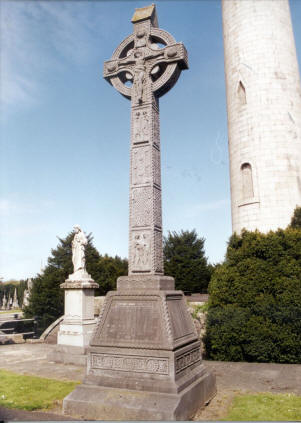 |
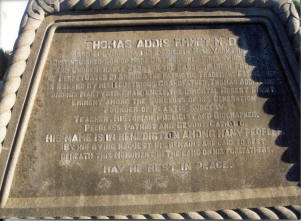
Grandson of Thomas Addis Emmet, United Irishman, and grand-nephew of Robert Emmet. Inherited all the family genius, with all the family patriotism. He was a medical doctor of much distinction, as well as a cultured litterateur, and was an acknowledged leader of Irish opinion in America. He was also an LL.D., a Fellow of the Ameri can College of Surgeons, a Knight Commander of the Order of St. Gregory (conferred on him by Pope Pius X.). In addition to many surgical works, he has left us many works of historical interest, notably his monumental work, The Emmet Family, published in 1898. He helped 0'Donovan Rossa, contributing the sum of 100 dollars per year to the aged Fenian's paper. Later he supported the Irish Parliamentary Party, sub scribing £10,000 to Redmond's funds. When the torch of Freedom was again lighted in 1916 Emmet returned to the Faith of his Fathers, and gave adherence to the insurrectionary movement. In the centenary year of Emmet's rising (1903) Dr. Emmet came to Ireland to institute investigations for Robert Emmet's grave. With regard to this work it is best to quote Mr. J. .T. Reynolds, the curator of the Municipal Art Gallery, who is now the only surviving member of the Committee which helped in this inquiry. Mr. Reynolds says: — |
Amongst the various places given, with all the energy of partisan zeal, as Emmet's last resting place may be mentioned Bully's Acre, St. Catherine's, St. Ann's, St. Michan's, Old Glasnevin, and St. Peter's, Aungier St.
On the approach of the centenary year (1903), in order to set the matter finally at rest, investigations were instituted by the late veteran representative of the Emmet family, Dr. Thomas Addis Emmet, of New York, the grandnephew of Robert Emmet, who through out his long life had sustained the traditions of his name, and was in later years the friend of Patrick Pearse. On his visit to Ireland he was enabled to obtain exceptional facilities in making actual examinations of the supposed graves of his famous ancestor.
NEGATIVE RESULTS: In each case there was a negative result—another melancholy example of the easy growth of myths, showing, if it did nothing more, the worthlessness of hearsay evidence—for the most part built on sentimental theories, or merely idle gossip—in deciding a question of historic fact. " After Dr. Emmet left Ireland the investigations were continued by the late J. F. Fuller, F.S.A., the well-known ecclesiastical architect, a kinsman of the Kerry branch of the Emmet family. He was assisted by Mr. F. J. Bigger, M.E.I.A., the Belfast Archaeo logist; by Sir Lambert Ormsby, President of the Royal College of Surgeons, Ireland, and by Alexander Fraser, Professor of Anatomy—all since dead. A full official report of the investigations can be read in the National Library of Ireland in the Memoir of Thomas Addis and Robert Emmet, by Thomas Addis Emmet, M.D., LL.D., New York, '1915. A detailed report appeared in the " Freeman's Jour nal " (3rd Jan., 1906), and in other Dublin papers, also in the " Irish World," New York (21st April, 1906). |
 |
Dr. Emmet's characteristically careful statement re the Trevor vault perhaps best fits the situation. ' It would require but a trifling corroboration from some other source to establish a complete chain of circum stantial evidence to prove at last the remains of Robert Emmet had been located.'
 |
The Trevor vault is in St. Paul's Churchyard, North King St. Dr. Trevor was superintendent of Kilmainham Jail in 1803. This vault was accidently discovered in 1898 and when its contents were examined by Dr. Emmet's wish, on 10th August, 1905, it was found to contain several coffins. All of them were of heavy oak ornamented and in some of them an inner leaden shell. One coffin was of very poor, cheap wood; the side had fallen out of it and exposed to view the skeleton within, when this was examined by the medical experts it was found to be that of a young man between the ages of twenty and thirty, and, strangest of all, the head was missing! The cavity in the coffin where the head should have been, was filled-in with shavings. This coupled with the story of Dr. Petrie's taking of the head of Robert Emmet for the making of the death-mask, and also the well-known story of the removal of Emmet's remains from the scaffold in Thomas St. to the vestibule of the jail, and the fact that Dr. Trevor was the superintendent of the jail gives a chain of very strong circumstantial evidence in favour of this vault as being the last resting place of Robert Emmet. |
Dr. Emmet desired to be brought home to Ireland, expressing the wish in his last will: "As I grow older my desire becomes stronger to rest finally in the land from which my family came." He set aside a sum of money for this purpose and also the design which his memorial was to follow: "To be made from stone, preferably gneiss." This monument is now in hands andwill shortly be erected.Dr. Emmet died on 1st March, 1919. aged 91 years. The funeral took place to Glasnevin on 15th September, 1922.
